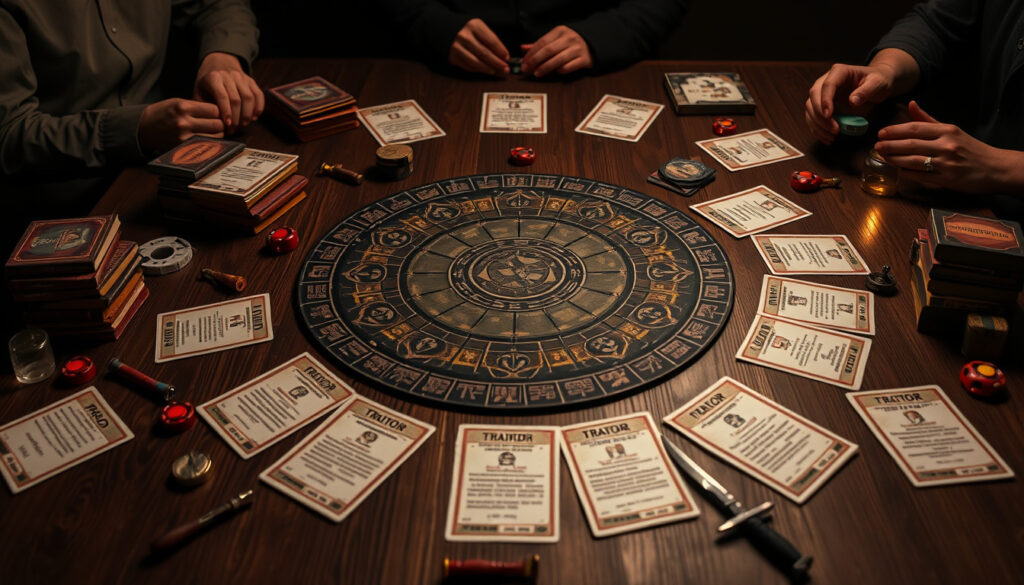
The Traitors Board Game – Rules, Setup and Play Guide
The Traitors Board Game brings the tension and drama of the hit BBC television series to the tabletop, offering a social deduction experience for groups of friends and family. Published by Drumond Park in collaboration with Goliath Games, the game captures the essence of televised betrayal, blindfolded missions, and dramatic votes that made the show a cultural phenomenon.
Designed for 4 to 8 players aged 8 and above, the game replicates the core mechanics of deception and alliance-building that define the original programme. Players take on the roles of either Faithful servants or a single hidden Traitor, working together on missions while secretly undermining each other’s efforts. The board game version became widely available in the United Kingdom following the show’s first season, which aired in 2022, and retails at approximately £20 to £25.
What Is The Traitors Board Game?
The Traitors Board Game is the official tabletop adaptation of the BBC television programme The Traitors, which itself draws inspiration from the Dutch original De Grote Verassing. The game translates the show’s signature elements—the blindfolds, the dagger, the gold treasure, and the tense round-table votes—into physical components that players handle directly around a table.
Unlike traditional party games with straightforward win conditions, The Traitors creates an atmosphere of calculated suspicion. One player secretly harbours treachery while the rest attempt to identify the betrayer through observation, discussion, and strategic voting. The Traitor, meanwhile, must navigate missions without revealing their identity while sabotaging the group from the shadows.
Drumond Park, the UK-based publisher known for family entertainment products, released the board game in 2023. The company collaborated with Goliath Games for broader distribution, making the product available through major retailers including Vivid Toys and Games. An official rules PDF became accessible through Ginger Fox’s website, allowing potential buyers to familiarise themselves with the mechanics before purchasing.
The board game should not be confused with The Traitors Card Game, a separate product also published by Drumond Park and Ginger Fox. The card game variant uses hand management mechanics, allows full elimination of banished players, and integrates with a companion application for enhanced gameplay.
Quick Reference
| Attribute | Details |
|---|---|
| Players | 4 to 8 |
| Age Rating | 8 and above |
| Publisher | Drumond Park (UK) |
| Release Year | 2023 |
| Price Range | £20 to £25 |
| Play Time | 20 to 40 minutes |
Key Features
- Official adaptation based on the BBC television series
- Social deduction gameplay with one hidden Traitor per game
- Four distinct phases per round creating varied gameplay moments
- Gold economy system rewarding successful play for both sides
- Blindfolds amplify tension during missions and murders
- Endgame betrayal twist determines the final winner
How Do You Play The Traitors Board Game?
The game unfolds across four complete rounds, with each round containing four distinct phases that alternate between cooperation and confrontation. Understanding the flow of these phases proves essential for meaningful play, as each phase presents different opportunities for the Traitor to act and the Faithful to gather information.
Before gameplay begins, participants receive their role cards in secret. One random player becomes the Traitor while everyone else receives Faithful cards. Players then claim their sections of the game board, each positioned around a central treasure chest area, and collect their starting gold pieces—three gold pieces and one gold bar each. The reward cards shuffle into a draw pile while remaining gold pieces form the prize pot and bank.
The Mission Phase
All players don their blindfolds simultaneously, creating an environment where observation becomes impossible for most participants. A reward card draws revealed, describing a cooperative challenge that the group must complete together—for example, coordinating a count or performing a collective action.
The Traitor, however, removes their blindfold in secret to read a separate sabotage objective. While the faithful players work on the mission, the Traitor must secretly undermine the effort according to their instructions. Music or background noise often helps mask the Traitor’s covert activities. If sabotage succeeds, the Traitor earns the right to murder a player during the Murder phase. If sabotage fails, the Traitor cannot kill that round, adding strategic stakes to every mission attempt.
The Banishment Phase
Players remove their blindfolds and gather at the round table for open discussion. Suspicion circulates freely as players debate who among them might harbour treachery. Each participant writes their chosen suspect on a voting sheet, and votes reveal aloud simultaneously.
The player receiving the most votes faces banishment. Banished players surrender two gold pieces to the bank and must remain silent for the remainder of the round—they cannot vote and cannot speak during discussions. Crucially, banished players remain in the game and keep their role secret. If voting results in a tie, both tied players lose one gold piece each. This mechanic creates fascinating strategic dilemmas, as players must weigh accusations against the gold cost of being wrong.
Experienced players often spread their votes to avoid triggering ties, while the Traitor may strategically vote alongside the majority to avoid suspicion. Faithful players who vote incorrectly still lose influence but can continue gathering information throughout remaining rounds.
The Armoury Phase
The banished player visits the Armoury privately and chooses between two tokens: a shield or a dagger. The shield grants protection against murder for the remainder of the game—if the Traitor attempts to kill a shielded player, the Traitor loses gold and the Faithful gain a bonus. The dagger, conversely, empowers the group: if the Traitor murders a player incorrectly, the remaining Faithful divide gold as punishment for the Traitor’s misjudgment.
This choice creates fascinating information asymmetry. A player who selects the shield signals potential distrust of the group, while a player choosing the dagger suggests confidence in their Faithful status—or a Traitor attempting to frame another player. The Armoury phase transforms banishment from pure punishment into a tactical decision point.
The Murder Phase
Blindfolds return for the Murder phase, but only if the Traitor successfully completed sabotage during the mission. The Traitor points the dagger spinner toward their intended victim’s board section. When blindfolds lift, the targeted player either falls to murder or survives based on their Armoury choice.
Murdered players exit the game but may keep their gold. Shields block murder attempts entirely. If the Traitor murders a non-Faithful player—a grave error—the remaining Faithful players receive gold rewards, incentivising accurate identification. This asymmetry rewards patient play: the Traitor must balance aggression against the risk of exposing themselves through mistaken murders.
Endgame and Final Revelation
After four complete rounds, the endgame triggers. A final banishment occurs, with the most-voted player forced to reveal their role publicly. If a Faithful player is banished and the Traitor remains hidden, the Traitor must lift their blindfold immediately, exposing their deception.
The two players holding the most gold enter the finale. Both secretly write either “Faithful” or “Traitor” on their voting sheet backs. Several outcomes determine victory: if both finalists are Faithful, they split the prize pot with gold quantity breaking ties. If one finalist is the Traitor, that player claims everything. If both finalists are Traitors, the third-place gold holder wins the entire pot.
Faithful players earn gold for correctly identifying the Traitor during the final reveal, receiving 2 to 4 gold pieces as reward. The Traitor accumulates 2 gold pieces per successful murder throughout the game, creating competing incentive structures that shape play styles across different groups.
How Many Players and What Age Is It For?
The game accommodates between 4 and 8 players, creating intimate group dynamics where every vote and accusation carries significant weight. This player range sits lower than classic social deduction games like Werewolf or Mafia, which often support 10 or more participants, but the limited numbers enhance the personal nature of interactions.
Official recommendations specify age 8 and above, though parents and guardians should consider whether individual children handle themes of deception appropriately. The game explicitly involves lying, manipulation, and betrayal as core mechanics—not as negative consequences but as expected play patterns. Younger players may struggle to separate game fiction from personal relationships, while older children and adults typically navigate these dynamics without difficulty.
Community feedback suggests optimal experiences occur with 4 to 6 players. Smaller groups intensify suspicion dynamics as fewer players mean each accusation carries greater consequence. Larger groups of 7 or 8 provide more cover for the Traitor but can extend play time and make tracking inconsistencies more challenging.
Play Time Considerations
Typical gameplay sessions last between 20 and 40 minutes, with variation based on player count, group experience, and discussion intensity. First-time players often require additional time for rule familiarisation, particularly during the initial round. Seasoned groups who understand mechanics navigate more swiftly.
The four-round structure provides natural pacing, with each round lasting approximately 5 to 10 minutes depending on how extensively players discuss suspicions. Extended banishment debates can push individual rounds toward the longer end of this range, while decisive voting groups move more quickly.
What Components Are Included?
The Traitors Board Game ships with substantial physical components designed to immerse players in the programme’s aesthetic. The central game board features a distinctive design centred around a rotating dagger spinner that determines murder targets and breaks ties during voting.
Every player receives a blindfold, ensuring the Mission and Murder phases function as intended. These blindfolds create genuine uncertainty about player actions during critical moments. Voting equipment includes laminated voting sheets and plastic stands for each participant, allowing silent anonymous voting followed by clear result presentation.
Gold and Economy Components
- One gold bar per player (distributed at setup)
- Three gold pieces per player (distributed at setup)
- Additional gold pieces for bank and prize pot
- Gold tracking integrated into the board design
Cards and Documentation
- Role cards: one Traitor card plus Faithful cards matching player count
- Twelve reward and mission cards
- Gameplay overview cards for each player
Notably, the game does not include pens or paper for voting, requiring players to supply their own writing implements. This omission appears deliberate, encouraging groups to use existing resources rather than generating additional waste. The official rules documentation clarifies component expectations and provides detailed phase-by-phase instructions for players seeking comprehensive guidance.
Where to Buy and Reviews
The Traitors Board Game is available through major UK toy retailers including Vivid Toys and Games, with supplementary stock through independent game shops and online marketplaces. The recommended retail price sits at approximately £20 to £25, though promotional pricing and bundle offers occasionally reduce the effective cost.
Drumond Park maintains direct retail partnerships while the official rules PDF remains freely accessible through Ginger Fox’s website, allowing prospective buyers to review mechanics before committing to purchase. This transparency supports informed buying decisions and reduces returns.
Critical Reception
Published reviews highlight the game’s successful translation of television tension into a tabletop format. The blindfold mechanic receives particular praise for creating genuine moments of uncertainty that video format cannot replicate. Players unfamiliar with the show reportedly enjoy accessible entry through the game, suggesting standalone entertainment value. If you’re interested in sustainable crafting, you can learn how to Gör egna ljus av gammalt stearin. Gör egna ljus av gammalt stearin
One detailed review from Joanna Victoria notes strong replayability, with varied mission cards and different social dynamics each session. The reviewer confirms optimal group sizes fall between 4 and 6 players, with larger gatherings potentially diluting the intimate suspicion that makes the game compelling. The card game variant receives separate assessment, with hand management mechanics and app integration distinguishing it from the board game version.
Community ratings on BoardGameGeek cluster around 6 to 7 out of 10 for the social deduction category, indicating solid but not exceptional design quality. These scores reflect established social deduction players who may find the game’s structure more restrictive than open-form alternatives, while newcomers often express greater enthusiasm.
Stock availability fluctuates seasonally, with heightened demand following television season broadcasts. Checking multiple retailers often reveals better availability than focusing on a single source. Some retailers offer bundle deals including both the board game and card game variants.
Traitors Board Game Compared to Werewolf
The Traitors Board Game shares conceptual DNA with classic social deduction games like Werewolf and Mafia, yet implements its mechanics quite differently. Understanding these distinctions helps players with prior experience adjust their expectations and strategies accordingly.
Werewolf and Mafia typically proceed through open-ended rounds until resolution, with werewolves voting secretly to eliminate villagers each night while villagers debate and vote to eliminate werewolves during daylight. The Traitors, by contrast, structures play into exactly four rounds with predetermined phases, removing the possibility of extended cat-and-mouse gameplay.
| Aspect | The Traitors Board Game | Werewolf / Mafia |
|---|---|---|
| Structure | Fixed 4 rounds with mission phases | Open-ended until resolution |
| Components | Board, blindfolds, gold economy | Minimal: cards or tokens only |
| Traitor Ratio | One Traitor per game | Multiple werewolves possible |
| Elimination | Banished players stay silenced | Eliminated players exit fully |
| Special Roles | Armoury shields and daggers | Seer, doctor, and other specials |
| Player Count | 4 to 8 players | 6 to 20+ players |
| Play Time | Approximately 30 minutes | 20 to 60 minutes |
The gold economy in The Traitors introduces material consequences that Werewolf lacks. Every action—successful missions, banishment, murder—affects gold distribution, creating quantitative stakes alongside qualitative suspicion. The Traitor who murders incorrectly loses economic advantage, while the Faithful who correctly identify the betrayer earn direct rewards.
Banished players in The Traitors remain present but silenced, creating unique dynamics where suspected traitors can still observe and potentially influence Armoury and Murder decisions indirectly. Werewolf eliminates players entirely, focusing discussion on remaining participants and intensifying scarcity as games progress.
Timeline: From Television to Tabletop
The board game’s existence traces directly to the television programme’s success, with a relatively compressed development timeline reflecting commercial interest in the property.
- 2022: The Traitors Season 1 broadcasts on BBC, becoming a cultural phenomenon with millions of viewers and extensive media coverage.
- 2023: Drumond Park announces and releases the official board game adaptation in collaboration with Goliath Games.
- 2023 onwards: The card game variant releases separately, offering alternative mechanics through hand management and app integration.
The proximity between television success and product release suggests deliberate commercial timing, capitalising on audience enthusiasm while viewer numbers remained high. Subsequent seasons of the programme likely sustain interest in branded merchandise.
Confirmed Information and Open Questions
Available documentation and community discussion clarify several aspects of The Traitors Board Game while leaving some questions unanswered for prospective buyers.
| Confirmed Details | Unresolved Questions |
|---|---|
| 4 to 8 player support | Potential future expansions |
| Age 8 and above recommendation | Possible US market edition differences |
| Four-round structured gameplay | Digital companion application plans |
| Gold economy and scoring | Tie-breaking procedures beyond dagger spin |
| Drumond Park as publisher | Community balance patches or errata |
| Approximately £20-25 retail price | International availability timeline |
The separation between board game and card game variants creates potential confusion for buyers, as marketing materials do not consistently distinguish between the two products. Community resources help clarify differences, but official documentation could improve transparency.
Understanding the Game’s Appeal
The Traitors Board Game succeeds by compressing the essential drama of its source material into a format that groups can experience repeatedly. The television programme’s appeal derives from watching real people navigate deception under pressure; the board game translates this into direct participation where players author their own moments of tension and revelation.
The gold economy deserves particular credit for creating mechanical stakes beyond simple win conditions. Both Traitors and Faithful accumulate resources throughout play, with victory requiring not just correct identification but also economic success. This dual-track scoring rewards strategic play over pure luck of accusation.
Group dynamics shift dramatically based on player count, familiar relationships, and gaming experience. Playing with strangers emphasises pure strategy and quick accusation, while playing with friends allows for longer social manipulation and dramatic reveals that non-participants cannot appreciate. The game’s design accommodates both playstyles within its structured framework.
Sources and Official Documentation
Several primary sources inform this analysis of The Traitors Board Game, with varying levels of official authority and community verification.
The official rules documentation published by Drumond Park and Ginger Fox provides authoritative mechanical guidance, including comprehensive phase descriptions, component lists, and example gameplay scenarios. The document clarifies ambiguities that community sources sometimes interpret differently.
Community resources like BoardGameGeek aggregate player experiences and ratings, offering comparative perspective against similar social deduction games. Individual reviews provide anecdotal evidence regarding replayability and group satisfaction that official materials do not address.
Video tutorials on YouTube demonstrate actual gameplay, allowing prospective players to observe mechanics in action before purchasing. These resources prove particularly valuable for visual learners who struggle with text-only rulebook comprehension.
Summary
The Traitors Board Game delivers a faithful adaptation of the BBC programme’s core tension, translating blindfolded missions, dramatic votes, and hidden betrayal into physical components that groups can experience at their own tables. Designed for 4 to 8 players aged 8 and above, the game supports sessions of 20 to 40 minutes through its structured four-round format.
The gold economy and armoury choices distinguish this offering from simpler social deduction games, rewarding strategic play alongside accurate accusation. Published by Drumond Park at approximately £20 to £25, the game represents accessible entertainment for groups seeking tension-heavy party experiences without complex rule overhead.
For readers exploring related content, BBC iPlayer offers access to the television programme that inspired this board game, providing context for those unfamiliar with the original format. Scotland destinations coverage on our site connects to related travel content, reflecting the programme’s Scottish filming locations.
Frequently Asked Questions
Is the Traitors Board Game fun?
Community reviews indicate positive experiences, particularly for groups of 4 to 6 players who enjoy social deduction mechanics. The blindfold system receives specific praise for creating genuine tension that video-only formats cannot replicate.
What is the price of the Traitors Board Game in the UK?
The recommended retail price stands at approximately £20 to £25, though promotional offers and retailer variation may affect actual transaction prices.
Is there a Traitors Board Game?
Yes, Drumond Park published the official board game adaptation in 2023, with components including game board, blindfolds, gold pieces, role cards, and mission cards for 4 to 8 players.
How long does the Traitors Board Game take to play?
Typical sessions last between 20 and 40 minutes, with variation based on player count, discussion intensity, and group familiarity with the rules.
Can I use BBC iPlayer to understand the game before buying?
Yes, the television programme demonstrates all core mechanics in action, helping potential buyers understand gameplay dynamics before purchasing the physical product.
What is the difference between the board game and card game?
The card game variant uses hand management mechanics, allows full elimination of banished players, and integrates with a smartphone application. The board game version features a central board, gold economy, and silenced banishment.
Does the Traitors Board Game work with fewer than 4 players?
The game specifies support for 4 to 8 players, with the lower bound representing a minimum threshold for meaningful social deduction dynamics to emerge.
Where can I find the official rules?
Ginger Fox publishes the official rules PDF through their website, providing comprehensive phase-by-phase guidance and clarifications for players seeking authoritative documentation.
More related posts
 King Size Bed with Storage – Complete UK Buyer’s Guide 2025
 Cast of Law & Order: Special Victims Unit – Full SVU Cast Guide
 Attendance Allowance Claim Form – Step-by-Step UK Guide
 Shepherds Hut with Hot Tub – UK Guide to Top Locations
 Colour Wow Dream Coat – Frizz Control Lasting 3-4 Washes
 Claudia Heffner Peltz – Biography, Age, Children and Wedding Controversy
 Bradford Clean Air Zone – Complete Guide for Drivers
 Hazel Irvine – Career, Family, and Snooker Absence
