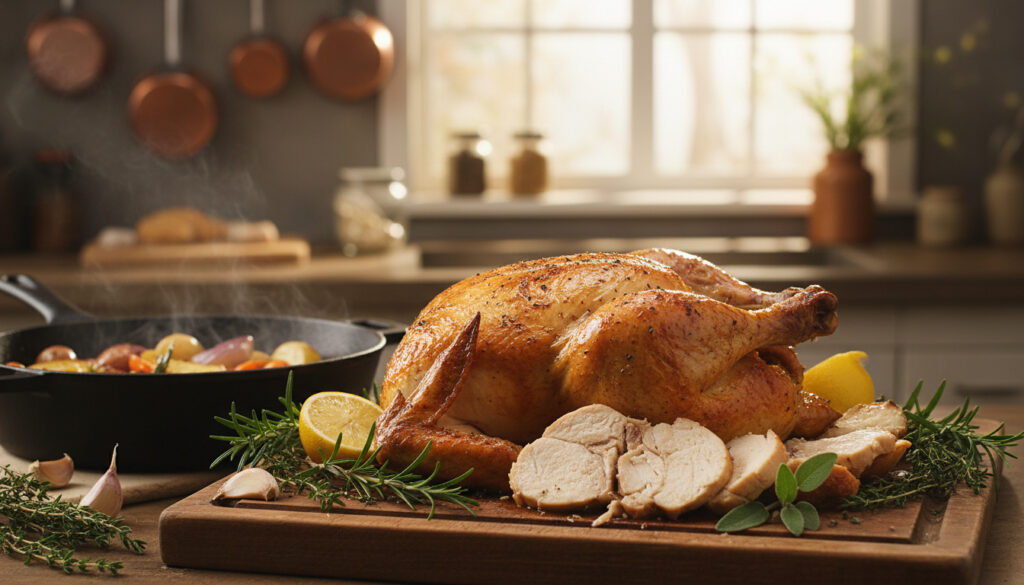
How to Roast a Chicken – Crispy Skin and Juicy Meat
Roasting a whole chicken represents one of the most efficient methods for producing a complete dinner with minimal active preparation. The technique transforms a raw bird into a meal with crackling golden skin and succulent meat through precise temperature control and patience.
Despite its reputation as a fundamental cooking skill, many home cooks encounter dry breast meat or pale, rubbery skin. Success requires understanding the interplay between moisture management, heat levels, and resting periods rather than following arbitrary timelines.
What Temperature and Time Should You Roast a Chicken?
Precise temperature management separates juicy results from disappointment. The USDA identifies 165°F as the safe minimum internal temperature for poultry breast meat, while thighs benefit from reaching 175-180°F to allow collagen breakdown.
Timing depends entirely on bird size and method. A 4-5 pound chicken typically requires 65 to 80 minutes total when roasted uncovered, though residual heat continues cooking the meat during the resting phase through carryover cooking, raising internal temperatures by 5-10°F.
- Select birds weighing 3-5 pounds for optimal heat penetration
- Start at 375°F for even cooking, then blast at 450-475°F to finish
- Insert thermometer into thickest thigh portion, avoiding bone
- Remove from oven at 160-165°F breast, 165-175°F thigh
- Rest 15-20 minutes tented loosely with foil
- Never roast from frozen; thaw 24-48 hours in refrigerator
| Method | Start Temperature | Finish Temperature | Duration (3-5 lb) | Result Characteristics |
|---|---|---|---|---|
| Traditional Two-Stage | 375°F | 450°F (after 40 min) | 65-90 minutes | Crispy skin, even cooking |
| Single High Heat | 425°F | — | 40-50 minutes | Simpler process, best for brined birds |
| Spatchcock | 425-450°F | — | 40-50 minutes | 30-40% faster, uniform crispiness |
| High Blast Finish | 375°F | 475°F | Variable | Professional-level browning |
| Air-Dried Only | 425°F | — | 60-75 minutes | Enhanced Maillard reaction |
| Stuffed Cavity | 375°F | 450°F | 75-90 minutes | Additional moisture from aromatics |
Safeway cooking guidelines confirm that positioning the bird on a rack over a pan with one cup of water captures drippings without steaming the skin, while the high-heat finishing method demonstrates how blast temperatures create the desirable Malliard reaction responsible for complex flavor development.
Should You Cover the Chicken and How to Prep It?
Preparation begins long before the oven preheats. Proper drying and trussing create the physical conditions necessary for crispy skin and even cooking, while covering decisions directly impact texture outcomes.
Should you cover chicken with foil when roasting?
Leave the bird uncovered throughout the entire cooking process. Covering traps steam and moisture against the skin, preventing the Maillard reaction that produces golden brown color and flavor. The dry, circulating heat of an uncovered oven allows amino acids and sugars on the skin surface to react above 300°F, creating the characteristic crackling texture.
How to prepare a chicken for roasting
Remove the chicken from refrigeration 30 to 60 minutes before cooking to eliminate the temperature differential between exterior and interior. Pat the cavity and skin thoroughly with paper towels to remove surface moisture; alternatively, air-dry uncovered in the refrigerator for 1 to 8 hours to further dehydrate the skin.
Apply dry brine by generously salting the skin and cavity, then refrigerate for 12 to 24 hours—or a minimum of 1 to 8 hours if time-constrained. The salt initially draws moisture out through osmosis, then reabsorbs it into the meat proteins, creating juicier flesh and a seasoned crust.
Do you need to truss the chicken?
Trussing serves functional purposes beyond aesthetics. Tuck wingtips behind the back and tie the drumsticks together with kitchen twine to create a compact shape. This prevents the legs from splaying outward and overcooking while ensuring the breast meat retains moisture through reduced surface exposure.
Should chicken be at room temperature before roasting?
Yes, the 30 to 60 minute counter rest proves essential for uniform doneness. Starting with a cold bird typically results in a cooked exterior surrounding undercooked joints near the bone. However, do not leave raw poultry at room temperature beyond this window to prevent bacterial proliferation.
For optimal results, salt the chicken 12 to 24 hours before cooking. This extended period allows salt to penetrate deeply into the muscle fibers, altering protein structure to retain moisture during high-heat exposure. Even one hour of salting improves outcomes compared to immediate cooking.
How to Get Crispy Skin and Great Flavor?
Achieving shattering, golden skin requires manipulating food science rather than applying oil or butter. The Maillard reaction—the chemical process creating browned flavors—demands a dry surface and temperatures exceeding 300°F.
What is the best way to get crispy skin?
Eliminate moisture through aggressive pat-drying and air-drying. Place the seasoned bird uncovered on a rack set inside a roasting pan to allow air circulation underneath. Video analysis demonstrates that high-heat blasting during the final 25 to 40 minutes drives off remaining surface moisture while creating the characteristic crackling texture.
Consider spatchcocking—removing the backbone and flattening the bird—to increase surface area exposure and reduce cooking time by 30 to 40 percent. This method eliminates the temperature differential between thick breast meat and thinner thigh sections, producing uniformly crispy skin across the entire surface.
What seasonings are best?
Salt provides the essential foundation, but aromatics enhance complexity without compromising texture. Stuff the cavity with lemon quarters, onion halves, and woody herbs such as thyme and rosemary. These ingredients perfume the meat from the inside while releasing steam that maintains moisture.
Optional herb butter slid beneath the breast skin adds richness, though excessive fat application can soften the exterior crust. Apply ground black pepper and all-purpose seasoning sparingly to avoid burning during high-heat finishing.
Residual heat continues cooking the chicken after removal from the oven. Internal temperatures rise 5 to 10°F during the 15 to 20 minute rest period. Removing the bird when the breast reaches 160-165°F prevents overcooking while ensuring it reaches the USDA minimum of 165°F.
Common Mistakes and How to Avoid Dry Chicken?
Dry poultry usually stems from preparation errors rather than cooking duration alone. Understanding the mechanical causes of moisture loss prevents repeated disappointments.
Why is my roast chicken dry?
Overcooking represents the primary culprit, but starting with wet skin prevents the formation of a protective crust that seals juices inside. Skipping the rest period proves equally damaging; slicing immediately after cooking causes protein fibers to contract and expel moisture onto the cutting board rather than redistributing it within the meat.
Low constant temperatures produce pale, chewy skin that fails to protect the underlying meat. Without the high-heat blast phase, the exterior never develops the barrier necessary to retain internal moisture during extended cooking.
Can I roast a frozen chicken?
Never roast poultry from frozen. The exterior meat reaches dangerous temperature zones while the interior remains ice-cold, creating food safety hazards and uneven cooking. If using frozen chicken, thaw completely in the refrigerator for 24 to 48 hours. Thawing at room temperature promotes bacterial growth on the exterior while the interior remains frozen.
Avoid rinsing raw chicken under water, which spreads bacteria through aerosolized droplets. Cooking to the proper internal temperature kills pathogens without washing. Verify doneness with an instant-read thermometer inserted into the thickest part of the thigh without touching bone.
What Is the Complete Roasting Timeline?
- Salt and air-dry: Apply dry brine 12-24 hours before cooking (minimum 1-8 hours if constrained). Leave uncovered in refrigerator to dehydrate skin.
- Room temperature rest: Remove from refrigerator 30-60 minutes before cooking to equalize internal temperature.
- Initial roast: Cook 40 minutes undisturbed at 375°F on lower-middle rack to establish base doneness.
- High-heat finish: Increase to 450-475°F for 25-40 minutes without opening oven door to achieve Maillard browning.
- Thermometer check: Verify thigh reaches 165-175°F and breast reaches 160-165°F in thickest sections.
- Resting period: Tent loosely with foil for 15-20 minutes to allow carryover cooking and juice redistribution.
Established Facts vs. Variables in Roast Chicken
- USDA minimum safe internal temperature: 165°F
- Maillard reaction requires >300°F surface heat
- Dry brining alters protein structure to retain moisture
- Carryover cooking raises temp 5-10°F during rest
- 3-5 lb birds cook most evenly
- Exact minutes per pound vary by calibration
- Pan material affects browning speed
- Benefit of flipping halfway through roasting
- Optimal salt quantity for individual taste preferences
- Specific timing for high-blast finishing phase
The Context Behind Roast Chicken
Roast chicken occupies a unique position across culinary traditions as both celebration food and weeknight staple. The technique predates modern kitchens, relying on the fundamental physics of radiant heat and air circulation rather than specialized equipment.
Unlike frying or sautéing, roasting requires minimal added fat while rendering the bird’s own subcutaneous fat into a self-basting mechanism. This produces a naturally rich flavor profile while maintaining a relatively simple one-pan cleanup process that appeals to contemporary home cooks managing time constraints.
Sources and Expert Guidance
The United States Department of Agriculture establishes that poultry reaches safe consumption levels at 165°F internal temperature, though dark meat achieves optimal tenderness between 175-180°F as connective tissue collagen breaks down into gelatin.
USDA Food Safety Guidelines
Dry brining remains the most effective method for home cooks because salt penetrates muscle fibers, dissolving proteins and allowing them to retain more moisture during heat exposure compared to unseasoned meat.
Culinary Video Analysis
Summary
Perfect roast chicken requires selecting a 3-5 pound bird, applying salt 12-24 hours ahead, drying thoroughly, and cooking uncovered at 375°F for 40 minutes before blasting at 450-475°F until the breast reaches 160-165°F and thighs hit 165-175°F. Rest 15-20 minutes before carving. For guidance on other precise techniques, see Pornstar Martini How to Drink – Creator’s Proper Order Guide.
Frequently Asked Questions
What size chicken works best for roasting?
Select birds weighing 3-5 pounds. Larger chickens often dry out breast meat before thighs reach safe temperatures, while smaller birds cook too quickly for proper skin crisping.
How long does a 4 lb chicken take to roast?
Expect 65-80 minutes total using the two-stage method (375°F for 40 minutes, then 450°F until done). Spatchcocking reduces this to 40-50 minutes at 425-450°F.
Can I roast chicken without a roasting rack?
Yes, though elevating the bird prevents the bottom from steaming in rendered juices. Use a bed of root vegetables or crumpled foil to create air circulation underneath.
Is it safe to cook stuffing inside the chicken?
Stuffing must reach 165°F internally, which often requires overcooking the meat. Aromatics like lemon and herbs flavor the bird safely without the food safety risks of dense stuffing.
How do I know when the chicken is done without a thermometer?
Juices should run clear when thigh is pierced, and leg joints should move freely. However, thermometers provide the only reliable verification of safe internal temperatures.
Can I use dried herbs instead of fresh?
Fresh woody herbs like rosemary and thyme tolerate long roasting better than dried, which may burn. If using dried, apply sparingly to the skin rather than stuffing the cavity.
More related posts
 Hazel Irvine – Career, Family, and Snooker Absence
 Cast of the Penguin – Complete Guide to Every Actor and Character
 Logan Paul – Net Worth, Wife and WWE Career in 2025
 The Traitors Board Game – Rules, Setup and Play Guide
 Side Effects of Propranolol – Common Risks and Dosage Guide
 Gamma Telecom Holdings Ltd – Company Profile and Services
 Amazon Customer Service Contact Number 0800 UK Free – Hours & Tips
 Luton Town FC vs Coventry City FC Standings – H2H Stats, Form & Predictions
