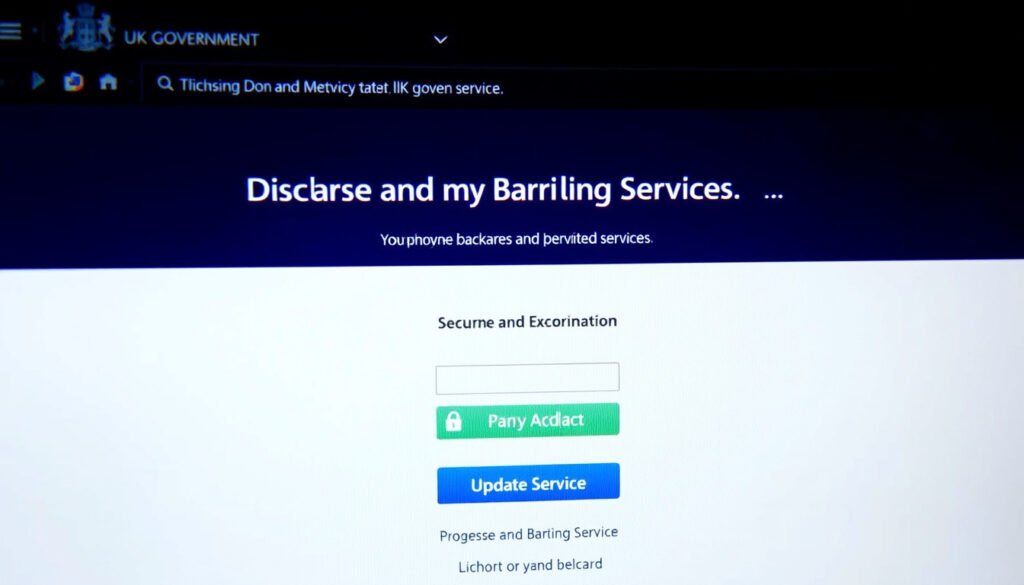
Disclosure and Barring Service – Login, Update Service & Contact Guide
The Disclosure and Barring Service helps employers across the UK make safer recruitment decisions by providing criminal record checks and maintaining barred lists for vulnerable groups.
Established as a non-departmental public body sponsored by the Home Office, the DBS operates across England, Wales, Scotland, and Northern Ireland through regional equivalents. Understanding its services, login options, and contact methods remains a common need for both employers and individuals navigating vetting requirements.
This guide explains how to access DBS systems, outlines the various check types available, and provides practical contact information for those seeking support.
How do I log in to the Disclosure and Barring Service?
Accessing DBS services requires navigating to the appropriate online portal based on whether you are an individual applicant, an employer conducting multiple checks, or a volunteer organisation.
The primary login points include the main DBS portal on GOV.UK for applications and updates, as well as the dedicated Update Service portal for certificate management. Organisations conducting 100 or more checks annually can register directly with the DBS, while smaller employers typically use approved umbrella bodies to process applications on their behalf.
A UK government body that conducts criminal record checks for employers
The Home Office
Enabling safer recruitment decisions across public, private, and voluntary sectors
Via GOV.UK portals and approved third-party organisations
Individuals applying for basic checks can complete the process entirely online through the DBS website or through authorised third-party providers. The system generates certificates that are sent to the applicant’s registered address, with conviction data sourced from the UK-wide Police National Computer.
- DBS replaced the previous Criminal Records Bureau (CRB) system in 2012, streamlining the vetting process under the Protection of Freedoms Act 2012
- The DBS Update Service allows certificate holders to reuse valid disclosures across multiple matching role applications
- Three distinct check levels exist: Basic, Standard, and Enhanced, each serving different eligibility requirements
- Enhanced checks with barring functionality are required for roles involving regulated activities with children or vulnerable adults
- Organisations have a legal duty to refer individuals to the DBS when removing them from regulated activity due to relevant conduct or harm risk
- Certain minor offences are filtered from certificates after set periods, though violent and sexual offences are never removed
| Fact | Details |
|---|---|
| Full Name | Disclosure and Barring Service (DBS) |
| Organisational Type | Executive non-departmental public body |
| Government Sponsor | Home Office |
| Formation Date | December 1, 2012 |
| Predecessor Bodies | Criminal Records Bureau (CRB) and Independent Safeguarding Authority (ISA) |
| Phone Contact | +44 151 676 9390 (Monday to Friday, 09:00 to 17:00) |
| Online Contact | Webchat available via GOV.UK portal |
| Update Service Cost | £16 per year (free for volunteers) |
What is the DBS Update Service?
The DBS Update Service launched on June 17, 2013, as a practical tool for individuals who hold standard or enhanced certificates and may need to demonstrate their status across multiple employment opportunities.
For an annual fee of £16 (free of charge for volunteers), subscribers can maintain their certificate status without requiring new applications for each role. This proves particularly valuable for professionals who regularly move between positions in sectors requiring background checks, such as healthcare, education, or social care.
Employers can verify a certificate holder’s current status online by entering the individual’s certificate number and checking against DBS records, provided the applicant provides appropriate consent. This verification process confirms identity and authenticity without necessitating a full recheck.
Who benefits most from the Update Service?
Supply teachers, agency workers, and temporary healthcare staff often find the Update Service most advantageous, as they may undertake numerous separate applications within a short timeframe. Rather than paying for a fresh check with each new placement, maintaining an active subscription allows them to provide a single valid certificate to multiple employers.
The service does not create a new certificate but rather maintains the existing one in an updatable status. If new information were to arise that would affect the certificate, the DBS would notify the certificate holder, who could then choose whether to share their updated status with prospective employers.
Certificate holders should check their Update Service status regularly, particularly when approaching new employment opportunities, to ensure their disclosure remains valid and reflects any changes since the original application.
What is an Enhanced DBS check?
An Enhanced DBS check represents the most comprehensive level of criminal record disclosure available through the service. Beyond the information included in Standard checks, Enhanced checks incorporate local police records containing what is commonly referred to as “soft information.”
This soft information may include fixed penalty notices, acquittals, and unproven allegations that police deem relevant to the role in question. The inclusion of such information reflects the reality that formal convictions do not capture every instance of behaviour that might indicate a risk to vulnerable groups.
Enhanced check with barring information
For positions involving regulated activities as defined under the Safeguarding Vulnerable Groups Act 2006, Enhanced checks can include mandatory consultation with the DBS barring lists. These lists identify individuals who have been prohibited from working with children or vulnerable adults due to relevant conduct.
Roles falling under this category typically involve frequent contact with vulnerable groups, such as teaching positions, care work, or clinical healthcare roles. In these circumstances, the employer receives not only criminal records and soft information but also explicit confirmation of whether the applicant appears on any barred list.
Enhanced checks with barring checks are available only for positions explicitly listed in the Police Act 1997 regulations and the Rehabilitation of Offenders Act 1974 (Exceptions) Order 1975. Employers cannot request this level of check for roles outside these defined categories.
| Check Type | Contents | Typical Eligibility |
|---|---|---|
| Basic | Unspent convictions and cautions only | Any individual or role |
| Standard | All convictions, cautions, reprimands, and warnings (spent and unspent) | Roles specified in Exceptions Order (health, finance, justice) |
| Enhanced (standard) | Standard contents plus local police soft information | Exceptions Order roles plus Police Act regulations |
| Enhanced (with barring) | Enhanced contents plus DBS barred list check | Regulated activity positions with children or vulnerable adults |
How do I contact the Disclosure and Barring Service?
Those requiring assistance with applications, updates, or general enquiries have several options for reaching DBS support staff.
The main telephone helpline operates on +44 151 676 9390, available Monday to Friday from 09:00 to 17:00. An alternative number, 03000 200 190, also appears in official guidance as a contact option. Online support is available through the GOV.UK portal via webchat during standard business hours.
The DBS main office is located in Liverpool. Research did not confirm the existence of a Darlington office or address, despite this being a commonly searched query. Those specifically seeking a Darlington contact point should verify current information through the official GOV.UK portal, as operational arrangements may change.
Online application pathways
For applicants seeking to submit checks or manage existing certificates, the digital routes include the main DBS application portal and the dedicated Update Service interface. Both are accessible through links on the official GOV.UK DBS page.
Organisations requiring bulk processing can register directly with the DBS after meeting threshold requirements, while smaller employers typically engage umbrella bodies to handle applications on their behalf. This intermediary approach ensures consistent compliance with application procedures while reducing administrative burden for organisations conducting occasional checks.
Certificate delivery times vary depending on check type, application volume, and individual circumstances. Applicants should consult current guidance on the official portal for estimated timeframes and should not make employment decisions based on assumed processing speeds.
How has the Disclosure and Barring Service evolved?
Before 2012, the UK’s criminal record vetting system operated through two separate bodies: the Criminal Records Bureau (CRB), which processed disclosure applications, and the Independent Safeguarding Authority (ISA), which maintained barred lists for individuals prohibited from working with vulnerable groups.
The Protection of Freedoms Act 2012 mandated the merger of these organisations, recognising that fragmented responsibilities created inefficiencies and potential gaps in safeguarding practice. The new unified body, the Disclosure and Barring Service, began full operations on December 1, 2012.
The creation of the DBS brought criminal record checks and barring decisions under a single administrative structure, enabling more coordinated responses to concerns about individuals who might pose risks to vulnerable populations. This reorganisation also introduced updated procedures for handling sensitive information and responding to referral requests from employers and regulatory bodies.
- Pre-2012: The Criminal Records Bureau (CRB) processed disclosure applications while the Independent Safeguarding Authority (ISA) maintained barred persons lists
- May 2012: The Protection of Freedoms Act receives Royal Assent, mandating the creation of a unified body
- December 1, 2012: The Disclosure and Barring Service officially begins operations, replacing CRB checks
- June 17, 2013: The DBS Update Service launches, enabling certificate holders to maintain valid status online for £16 per year
- Ongoing: Service expansion continues with enhanced digital portals, updated eligibility criteria, and integration with employer onboarding processes
What is established and what remains unclear?
The following summarises the current state of knowledge regarding the DBS based on verified official sources.
- The DBS is a non-departmental public body sponsored by the Home Office
- It provides four levels of criminal record checks: Basic, Standard, Enhanced (without barring), and Enhanced (with barring)
- The main office is in Liverpool, with contact available by phone and webchat
- The DBS Update Service costs £16 annually for most users and is free for volunteers
- Employers have a legal duty to refer individuals to the DBS when dismissing them from regulated activity due to relevant conduct or harm risk
- Specific processing times for different check types are not consistently published and may vary by case complexity
- Claims regarding a Darlington address for the DBS could not be verified through official sources
- The 03000 200 190 number appears in some official guidance alongside the primary +44 151 676 9390 number, and applicants should confirm which line serves their specific enquiry type
- Digital service enhancements and portal updates occur periodically, meaning specific interface features may change
What is the broader context for criminal record checks?
Criminal record checks serve a fundamental role in contemporary safeguarding practice across the United Kingdom. By providing employers with accessible information about applicants’ backgrounds, the system aims to balance individual privacy rights against the obligation to protect children, vulnerable adults, and public interests.
The approach taken by the DBS reflects legislative choices about which information should be disclosed, how long certain data remains relevant, and which roles justify deeper investigation into personal history. The Rehabilitation of Offenders Act 1974 establishes the framework for determining when convictions become “spent” and therefore potentially filtered from disclosure, though this filtering does not apply to serious offences.
Equivalent services operate across the devolved administrations of the United Kingdom. Disclosure Scotland handles criminal record checks for Scottish residents, while Access NI performs the same function in Northern Ireland. This regional variation means that applicants working or relocating across UK borders may need to understand different application processes and timeframes.
What do official sources say?
The following statements reflect direct official guidance and descriptions of the DBS function.
The Disclosure and Barring Service helps employers in the public, private, and voluntary sectors make safer recruitment decisions by providing accurate and relevant information about criminal records.
— GOV.UK official guidance
DBS checks help organisations identify people who are unsuitable for certain roles, especially those working with children or vulnerable groups, by providing criminal record certificates that reveal relevant convictions and other information.
— NCVO safeguarding guidance
What are the next steps?
Those seeking to apply for a DBS check should first determine the appropriate level of disclosure for their role or circumstances by consulting the official GOV.UK DBS portal. Individuals unsure whether their position qualifies for a Standard or Enhanced check should seek guidance from their prospective employer or a qualified safeguarding advisor.
Certificate holders who anticipate needing to demonstrate their status repeatedly may find the Update Service a cost-effective option. The ability to have an employer verify status online without requiring a new application can significantly streamline employment transitions.
For queries not resolved through the online resources, contacting the helpline directly remains the most reliable method for obtaining personalised assistance. Those with complex circumstances, such as previous convictions, changing personal details, or appeals against barring decisions, should be prepared to provide additional documentation when engaging with DBS support staff.
Frequently asked questions
What is a DBS certificate?
A DBS certificate is an official document issued following a criminal record check. It details relevant convictions, cautions, or other information depending on the check level applied for, and is sent to the applicant’s home address.
How long does a DBS check take to process?
Processing times vary depending on the check type and individual circumstances. Basic checks can be completed relatively quickly online, while Enhanced checks may take several weeks, particularly if police forces need to provide soft information.
Can I use a DBS certificate for multiple jobs?
Standard paper certificates apply to one specific role at the time of application. However, subscribing to the Update Service allows certificate holders to maintain an active status that can be verified by employers for matching positions without requiring a new application.
Are spent convictions always shown on a DBS certificate?
Standard and Enhanced checks include spent convictions alongside unspent ones. Basic checks show only unspent convictions and cautions. Certain minor offences are filtered from certificates after defined periods, but violent and sexual offences are never filtered.
What does “regulated activity” mean?
Regulated activity refers to roles involving close, unsupervised contact with children or vulnerable adults, as defined under the Safeguarding Vulnerable Groups Act 2006. Positions in this category typically require Enhanced checks with barring checks.
How do I contact DBS if I have a complaint?
Complaints can be submitted through the official GOV.UK portal or by contacting the DBS helpline. Specific complaints about certificate content, barring decisions, or service delivery each have dedicated review procedures detailed on the official website.
Is there a charge for DBS checks?
Basic checks cost £18, Standard checks cost £26, and Enhanced checks cost £40. The Update Service costs £13 annually (discounted from £16). Volunteers are exempt from Update Service charges.
Can I apply for a DBS check for myself?
Individuals can apply for their own Basic DBS check directly through the DBS website or approved third-party providers. Higher-level checks must be requested by eligible employers or umbrella bodies on behalf of the individual.
More related posts
 K-Pop Demon Hunters – Netflix Release, Cast and Records
 Natalie Nunn – Real Name, Age, Husband and Net Worth 2025
 Pay Heathrow Drop Off Charge – How to Pay Online & Avoid PCN
 Is Liverpool Playing Today – Next FA Cup Match Details
 Televi ion Licen ing in the United Kingdom – 2025-26 Full Guide
 Catholic Church Near Me – Mass Times & UK Directories
 Football Today Premier League – Fixtures, Results and Live Scores
 Apply for Provisional Driving Licence – UK 2025 Guide
